
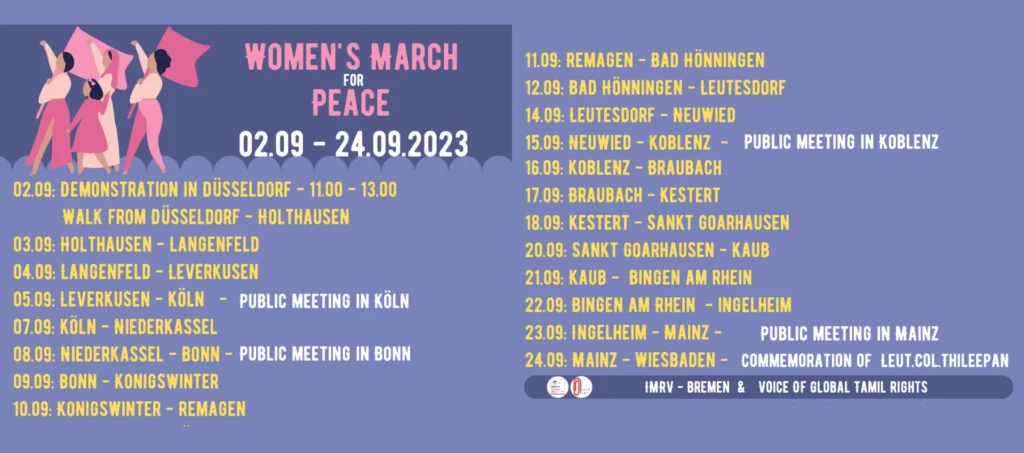
A group of women will walk from Duesseldorf (2 September) to Wiesbaden (24 September). Our aim is to build a political force against the instigators of genocidal wars, and systematic violence against women. What spurred us to embark on this action was the situation faced by the Eelam Tamils in the island of Sri Lanka. In 2009, during the war of extermination against the Eelam Tamils, according to the United Nations general secretaries internal Review Panel report, over 70,000 Tamils were unaccounted for. The actual number of deaths may be nearer 140,000 – and this, within the last 4 months of the war. The events of 2009 was the crescendo of the genocidal assault that had lasted for decades and was particularly marked by the organised sexual torture of women (see trophy videos made by Sinhala soldiers: maltreatment of bodies of female fighters, Execution). We are marching in Germany because although these terrible events happened far away from Europe, the trigger to the war came from geo-political events in which the EU and Germany was deeply involved in.
Germany’s pivotal role in the Sri Lankan peace process
At the turn of the century, the ascendant political tendency in the EU took the important step of promoting peace talks in Sri Lanka. The impetus for this came from people like the German Minister for Overseas Development, Heidemarie Wieczorek-Zeul. This was a dramatic break from the prevailing policy of the western countries – which had been to follow the British/US policy of encouraging and supporting the Sri Lankan state’s attempt to solve ‘the Tamil question’ by military means. Germany’s anti-war position was further elucidated by a group of four EU development ministers – all women. These women, the ‘Utstein Group’, advocated for ‘conflict transformation’, that is the process of moving from conflict, to a situation of sustainable peace. After examining several conflict-situations in different parts of the world, researchers in Germany found that Sri Lanka was the most likely place for such a negotiated solution to succeed. Certainly, at that time, the situation in the island was especially amenable to peace talks because the Tamil resistance – the Liberation Tigers of Tamil Eelam (LTTE) – had developed into a force that was militarily strong enough to fight the Sri Lankan armed forces to a standstill. The human and economic cost of continuing an unwinnable war made even the normally intransigent Sinhala ruling elite open to peace talks.
The role played by Tamil Women in achieving military parity
The Sri Lankan armed forces have used rape as a weapon of war since the 1980’s. After the 1983 anti-Tamil pogroms, as many young men left home to join the resistance movement, the Tamil women were seen as an easy target – and sexual violence was used as the primary method of terrorising the whole community. Rape became a policy of war. For example: a woman who threatened Sinhala soldier that she will report them to their senior officer was told by the soldier, ‘we were ordered to rape you’. The horror suffered by the women was felt deeply as a collective punishment for supporting the resistance. In the mid 80’s, responding to this unbearable situation, the women in Tamil Eelam began their comprehensive transformation from victimhood to physical resistance. To open up the armed struggle to women meant that the LTTE had to confront the semi-feudal structures and the deeply ingrained cultural norms which designated a certain role for women in Tamil society. To overcome this a thoroughgoing social revolution had to take place. The women Tigers formed an independent structure within the LTTE and became a formidable fighting force. It is the growing contribution of the women fighters within the LTTE that enabled it to achieve military parity with the Sri Lankan armed forces – even as the regime was receiving support by an increasing number of world powers. The military parity between the SL regime and the LTTE was an essential condition for the peace process in Sri Lanka to commence.
With our three-week march, we want to throw light, on the decisive, but hitherto hidden contribution of the women – Tamil women fighters in the island and the women of the Utstein group in Europe – in bringing the peace process in Sri Lanka into effect. We are embarking on this journey as the genocidal violence in the island erases from memory the four-year long peace process, very much like the Minsk Agreement fades from view as the war in Ukraine continues. The women’s march for peace is also a journey of discovery. Together – with all of you – we will aim to understand the economics and the geo-politics behind the terrible arc of wars and genocides burning through Africa, the Middle East, Asia and now Europe. The impulse to the initiate this march, is because we feel that, the more we understand the international complicity of the continuing genocidal war against the Eelam Tamils the more we realise that the Tamil case represents in microcosm the central features of the epoch we live in. And further, that the case of the Eelam Tamils, as well as exposing the victims of racial oppression and terror against women, also shows how it is also women who showed the possibility how to oppose it. We want you to bring your experience and understanding to the struggle so that we can ‘reason together’ to deepen our knowledge and strengthen our solidarity.
Why Duesseldorf and why Wiesbaden?
Wiesbaden, because, Heidemarie Wieczorek-Zeul, one of the people whose political intervention was crucial for the initiation and continuation of the peace process in Sri Lanka, lives there. Duesseldorf because the courts in that city convicted members of the Tamil Diaspora in Germany for collected money for use in the resistance to the war of extermination in their homeland. Nathan Thambi and Anandarajah used their hearing in Duesseldorf to argue that they are not guilty of any crimes, and that on the contrary, it is the categorisation of the LTTE as a terrorist organisation by the EU in the middle of a functioning peace process – destroying the ‘parity of esteem’ between the two negotiating parties – that triggered the massacre in the island. Their cases are now being considered by the constitutional court in Germany. We are arguing that the German government and the EU should have continued the policy put into action by the Utstein group. That it should not buckled under pressure from the US and the UK to ban the LTTE. That banning the LTTE was nothing to do with whether the LTTE was terrorist or not. That it had everything to do with the deliberate destruction of the peace process, so that the Tamil liberation movement which had sworn not to allow external military forces to occupy the strategically important Trincomalee harbour can be exterminated.